The Factory Floor Signals Everyone Ignores
December 9, 2025
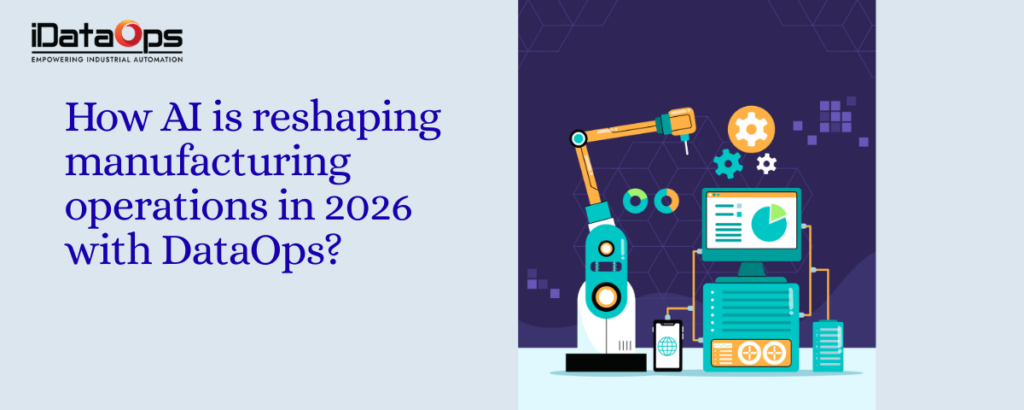
Why 2026 Is a Turning Point for Manufacturing AI
Artificial Intelligence in Manufacturing is no longer just a pilot project— it is transforming how factories operate every day. From predictive maintenance to supply chain optimization, AI is now part of production lines, plant operations, and enterprise systems. Yet scaling AI in real-world environments remains challenging. The problem is not the technology itself; it is how data is managed and prepared for operations.
For example: According to McKinsey 2025, over 70% of manufacturing AI projects fail to move beyond pilot programs, mainly because of poor data quality and operational issues.
In 2026, DataOps has become the backbone of reliable AI. By ensuring clean, validated, and timely data, DataOps allows manufacturers to turn isolated experiments into large-scale, production-ready intelligence.
Why Do AI Projects Struggle in Manufacturing?
Manufacturing environments are different from other industries. Data comes from many sources, such as PLCs, SCADA systems, MES, ERP platforms, IoT sensors, and external suppliers. Each source works at its own speed and format, which makes consistent data flow difficult.
Some of the main challenges include:
-
Inconsistent data pipelines: delays or errors affect model performance
-
Poor data quality: sensors may fail, manual input can be wrong, and data can be missing
-
Lack of traceability: unclear origin of data makes troubleshooting hard
-
Scaling issues: pilot projects rarely succeed across multiple plants
In fact: A 2025 Deloitte survey found that 40% of manufacturers experienced AI deployment delays due to unreliable operational data.
How AI Is Reshaping Manufacturing Operations in 2026
AI’s impact is clear across several areas. In 2026, the focus is on integrating AI into real-time operations rather than just running experiments.
Predictive Maintenance Becomes Standard
Moreover, AI predicts equipment failures before they happen, which reduces downtime and lowers maintenance costs. Sensors send data continuously, and AI models detect anomalies to optimize maintenance schedules automatically.
Quality Inspection Moves to Real-Time
In addition, AI-powered computer vision inspects products on the production line in real time. This reduces defects, increases throughput, and ensures consistent quality across shifts and plants.
Supply Chain and Inventory Optimization
Furthermore, AI models analyze demand, supplier performance, and production schedules. This helps optimize inventory, reduce waste, and respond faster to market changes, supporting lean operations.
Energy Management and Sustainability
Finally, AI monitors energy use across machines and plants. By identifying inefficiencies, AI recommends operational adjustments, helping reduce costs and lower the carbon footprint.
How DataOps Makes AI Work in Manufacturing
DataOps ensures AI can deliver results reliably and at scale. It plays a key role in every step of the AI lifecycle:
Reliable Data Ingestion
iDataOps collects data from sensors, machines, ERP systems, and supply chains consistently without disrupting operations.
Automated Data Validation and Quality Control
Moreover, automated monitoring detects missing values, anomalies, and schema changes, ensuring AI models always receive clean, production-ready data.
Traceability and Versioning
In addition, iDataOps tracks every dataset, feature, and model version, making it easy to audit AI decisions, fix issues, and improve operations continuously.
Seamless Delivery to AI Systems
Finally, validated data reaches AI models in real time, whether on the factory floor, at the edge, or in the cloud.
As a result, AI projects can scale without risk of errors or inconsistencies.
Which Manufacturing Areas Benefit Most from AI and DataOps?
-
Predictive Maintenance: Reduces unplanned downtime and extends equipment life
-
Defect Detection and Quality Control: Monitors production for consistent quality
-
Inventory and Supply Chain Management: Optimizes planning and reduces waste
-
Energy Efficiency: Provides AI-driven recommendations to save costs and energy
How Is DataOps Different from Traditional Data Pipelines?
| Traditional Pipelines | DataOps for Manufacturing AI |
|---|---|
| Batch-oriented | Real-time and streaming |
| Manual monitoring | Automated observability |
| Analytics-focused | AI-production focused |
| Limited traceability | Full lineage and versioning |
DataOps is more than a technical upgrade — it is the foundation for scaling AI across the enterprise.
What Leading Manufacturers Are Doing in 2026
Manufacturers that succeed in 2026 focus on:
-
Treating data as a key asset rather than a byproduct
-
Investing in observability and monitoring of AI pipelines
-
Aligning IT, OT, and data teams around shared goals
-
Building scalable DataOps architectures across plants and regions
These practices allow AI to be embedded into the operational DNA of the factory, not just run as isolated experiments.
Why iDataOps Is the Engine Behind Scalable AI
As AI moves from experiments to full-scale deployment, manufacturing success depends on how data is collected, managed, and delivered. iDataOps provides a complete, end-to-end data operations platform for industrial environments, solving key AI challenges:
Reliable Data Ingestion
High-frequency data from machines, sensors, ERP systems, and supply chains is collected consistently without disrupting operations.
Automated Data Validation and Quality Control
Built-in monitoring detects anomalies, missing values, and schema changes. AI models always receive clean, production-ready data.
Traceability and Versioning
Every dataset, feature, and model version is tracked. This makes it easy to audit decisions, debug issues, and improve operations.
Seamless Delivery to AI Systems
Validated data reaches AI models in real time, whether on the factory floor, at the edge, or in the cloud.
In short: iDataOps bridges the gap between operational data and actionable AI, allowing manufacturers to:
-
Scale AI across plants, shifts, and regions
-
Reduce downtime and operational risk
-
Improve product quality and throughput
-
Make faster, data-driven decisions
Ultimately, AI is reshaping manufacturing from the factory floor to enterprise operations — and iDataOps ensures this transformation is reliable, scalable, and production-ready across every operation.
Looking Ahead: AI and Manufacturing Operations in 2026
In 2026, AI stops being experimental and becomes mission-critical for manufacturing. Companies that combine innovative AI models with strong DataOps practices will lead the industry.
With iDataOps as the backbone, manufacturers can ensure AI is predictable, reliable, and scalable, delivering measurable impact across every operation.